Best Kids Yoga Mats: 8 Comfortable and Colorful Options for Young Yogis
Hand a child an adult mat and the practice stalls before it starts, the surface too wide to feel ownership of, the thickness wrong for small knees, the look of it about as inviting as a gym floor. Children practice through play, through animal poses and rainbow colors and the pride of unrolling gear that is unmistakably theirs, and the mat underneath them is either an invitation or an obstacle. That single difference explains why the kids’ corner of the mat market has grown into a world of its own, sized, cushioned, and illustrated for bodies still learning what balance means.
Choosing among the best kids yoga mats comes down to a short set of working differences. Material leads, because children spend more time face-down and hands-flat on their mats than any adult ever will, so 6P-free and phthalate-free PVC, or TPE with no PVC at all, are the labels that matter most. Thickness runs a close second, three millimeters suit light travel and older kids, while six-millimeter builds cradle the knees of wobbly tree poses. Then comes the fun layer, printed unicorns and pandas and pose-by-pose guides that turn a mat into a game, and the practical layer, wipe-clean surfaces, carry straps, and multi-packs built for classrooms.
The eight mats ahead separate on exactly those differences, material, cushion, print, and purpose, from single-child favorites to a ten-pack for a whole yoga corner. Match the mat to the child, and the hardest part of kids’ yoga, the getting-started, solves itself.
Quick Picks
Best Overall: Gaiam Kids Printed Yoga Mat — the category’s benchmark print mat with its deepest owner record.
👉 Roll Out the Gaiam on Amazon
Best Learning Set: Abtech Kids Mat with Pose Cards — mat, cards, and carry bag in one game-ready kit.
👉 Deal In the Abtech Set on Amazon
Best Cushion: Plyopic Kids TPE Mat — six millimeters of PVC-free comfort with a carry strap.
👉 Cushion Up the Plyopic on Amazon
Best Fun Prints: Antsy Pants Kids Mat — five playful colorways at the guide’s friendliest tag.
👉 Unroll the Antsy Pants on Amazon
Comparison Table
| Product Name | Best For | Price Range | Check Price on Amazon |
|---|---|---|---|
| Gaiam Kids Printed Yoga Mat 60×24 | The everyday benchmark | Budget | View Gaiam Kids Offer |
| Antsy Pants Kids Yoga Mat 60×24 | Fun-print value | Budget | Check Antsy Pants Offer |
| Abtech Kids Mat + Pose Cards Set | Learn-through-play kits | Mid | See Abtech Set Offer |
| Myga Childrens Mat with 8 Poses | Self-guided pose practice | Mid | View Myga Poses Offer |
| Bean Products Kids Non-Slip Mat | Grippy eco builds | Mid | Check Bean Products Offer |
| Hello Fit Bulk Kids Mats 10-Pack | Classrooms and playgroups | Premium | See Hello Fit Offer |
| Myga Silk Print Kids Mat | Lightweight play mats | Budget | View Myga Silk Offer |
| Plyopic Kids TPE Mat 6mm | Maximum cushion, PVC-free | Mid | Check Plyopic Offer |
Buyer’s Guide
The best kids yoga mats earn their spot on the playroom floor through details grown-up mat guides never mention, and the differences start with what the mat is made of. Five checkpoints carry the decision, and the first one is the one parents ask about first.
1. Kid-Safe Materials: Reading the Labels
Material is the first conversation in kids’ gear, and the mat industry answers with three honest tiers. Standard PVC mats get kid-approved when they carry 6P-free or phthalate-free labels, meaning the plasticizer family parents worry about has been engineered out. TPE takes the step further, a foam polymer with no PVC content at all, lighter in the hand and kinder to the planet’s conscience. Printed builds add ink to the question, and the better listings state their surface safety outright rather than hiding behind generic claims. The practical rule for a household is simple, read the label once, buy the tier that matches the family’s standards, and let the child choose the color within it.
2. Thickness: Small Knees, Real Floors
Adult thickness logic flips for children, because small bodies meet hard floors at different angles. Three millimeters, the classic kids’ gauge, keeps mats light enough for small hands to roll and carry, and suits five-to-eight-year-olds whose poses stay low and wide. Six millimeters is the knee-saver tier, worth it for toddlers, for hardwood and tile floors, and for the longer floor-based sessions where wobbly balance work lands joints repeatedly. The trade is bulk, thicker mats roll heavier and store prouder, and a mat a child cannot carry themselves is a mat that stays rolled. Match the gauge to the floor and the age, harder floors and younger yogis arguing for the deeper cushion.
3. Grip and Texture Under Playful Chaos
Kids do not flow, they bounce, scramble, and slide, which makes surface grip a safety feature rather than a performance nicety. Textured PVC surfaces and dual-texture TPE builds anchor palms and knees through the transitions adults never think about, and the difference shows the first time a downward dog turns into a wheelbarrow race. Print-heavy mats deserve a specific look here, some prioritize artwork over texture, and the smoothest faces can skid on hard floors. A quick home test settles it, press a damp palm and push, and any mat that slides under that pressure will slide under a giggling seven-year-old.
4. Prints, Pose Guides, and Learning Through Play
The artwork on a kids’ mat is not decoration, it is pedagogy. Character prints give a mat a personality a child adopts, which alone explains why unicorn and panda designs dominate the category’s reviews. Pose-printed mats go further and turn the surface into a self-guided class, numbered illustrations that let a five-year-old run their own practice without an adult directing traffic, and card-based kits extend the game off the mat entirely. The honest assessment is developmental, younger children thrill to characters, older ones graduate to pose guides, and the mat that matches the child’s stage gets used months longer than the one chosen purely on color.
5. Cleaning, Storage, and Multi-Pack Logic
Children’s mats live in the real world of juice, crumbs, and playground residue, so cleaning decides a mat’s actual lifespan. Wipe-clean PVC handles the daily mess with a damp cloth and mild soap, TPE asks for the same gentle treatment with less chemical tolerance, and every mat air-dries in minutes, which matters because a mat that is easy to clean gets cleaned. Storage follows the roll, straps and bags keep mats tidy and give small arms a handle, and multi-packs solve the classroom question outright, one mat per child in a stack of bright colors that sorts itself at a glance. Build the habit young, mat wiped and rolled after practice, and the gear teaches half the discipline by itself.
One Mistake to Avoid: Buying Grown-Up Thickness for a Growing Yogi
The reflexive upgrade, a thicker, longer, more serious mat because the child is getting stronger, quietly works against the practice it means to support. Full-size mats swallow a small frame’s sense of position, their extra surface becomes wandering room rather than workspace, and their weight turns the proud post-class roll-up ritual into an adult’s chore. The correction is to size the mat to the child rather than to the adult they will become, sixty-by-twenty-four inches already gives most school-age yogis genuine room, and the milestone that matters is grip and cushion, not length. Children graduate to adult mats on their own schedule, and a mat that fits today is the one that builds the habit that earns tomorrow’s.
Best Kids Yoga Mats: 8 Comfortable and Colorful Options for Young Yogis
The eight mats ahead cover the kids’ market from both ends, benchmark prints and cushioned TPE builds, pose-guide surfaces and card-based kits, plus one ten-pack that outfits a whole classroom, each matched to an age, a floor, and a learning style. Find the mat that fits the young yogi, and the practice starts itself.
1. Gaiam Kids Printed Yoga Mat, 60″ x 24″, 3mm (Twinkle Toes)
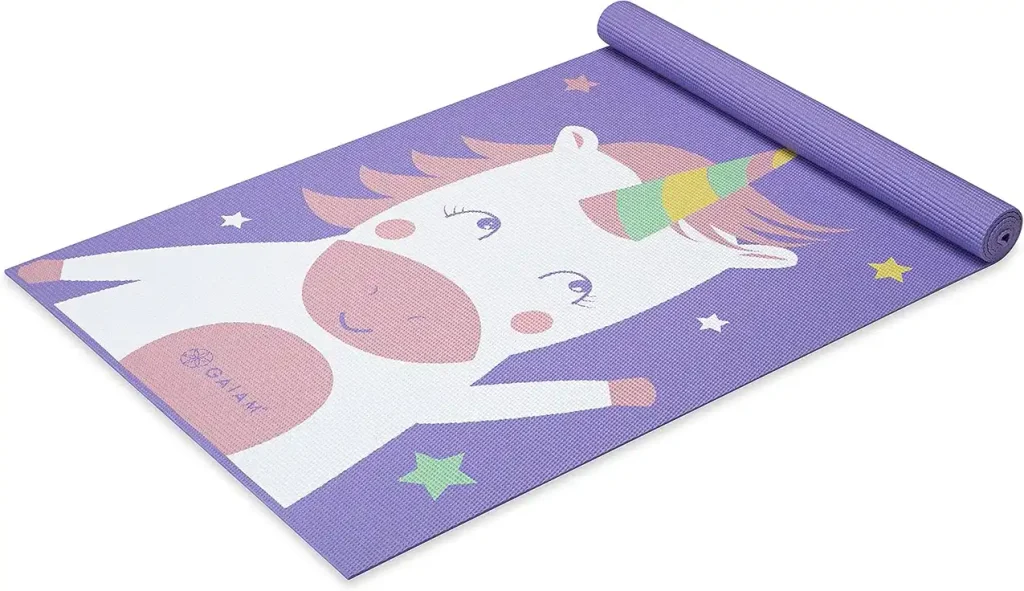
Best for: The everyday benchmark, the print mat that defines the category with its deepest owner record.
- Twinkle Toes Print: A unicorn-and-stars design that owns the category’s imagination.
- 6P-Free PVC: The kid-safe plasticizer label parents read first.
- Textured Non-Slip Surface: Grip tuned for small palms and knees.
- Downloadable Kids Class: A guided session bundled with the mat.
- The Category Benchmark: The deepest kids-mat owner record anywhere.
Pros:
- The most proven kids’ mat in the market
- Light three-millimeter roll small arms can carry
- First-party buy box with standard returns muscle
Cons:
- Thin gauge that hard floors will feel
- Print that softens after years of feet
- Sized for ages five to eight, no younger
Unroll the Gaiam Benchmark on Amazon
2. Antsy Pants Kids Yoga Mat, 60″ x 24″, 3mm (Pink Unicorn)
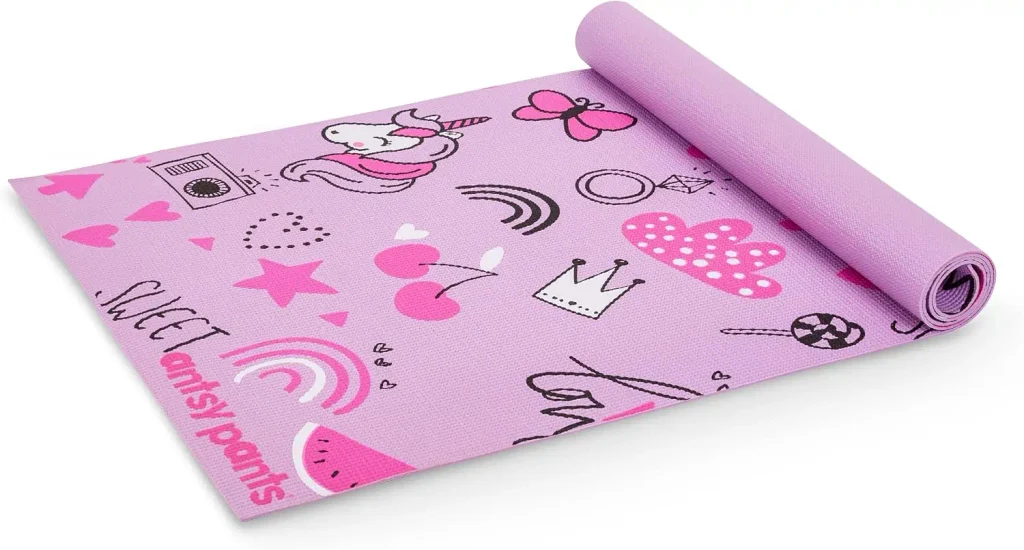
Best for: The fun-print value card, five playful colorways at the guide’s friendliest everyday tag.
- Five Print Colorways: Unicorn, dino, shark, butterflies, and bees on one platform.
- Phthalate-Free PVC: The safety label doing its job beneath the art.
- Classic 3mm Gauge: The light, rollable standard kids handle themselves.
- First-Party Retail: Sold straight from Amazon’s own shelves.
- Fun-Print Value: The guide’s friendliest tag among full-size kids mats.
Pros:
- The widest print choice at a single price point
- First-party buy box with fast standard delivery
- Doodle-style art that reads handmade rather than licensed
Cons:
- Print-dense surface with a smoother feel than textured rivals
- Younger listing still building its owner record
- Purchase quantity capped at four mats per order
Pick a Print From the Antsy Pants on Amazon
3. Abtech Kids Yoga Mat Set — Mat, 12 Pose Cards & Storage Bag
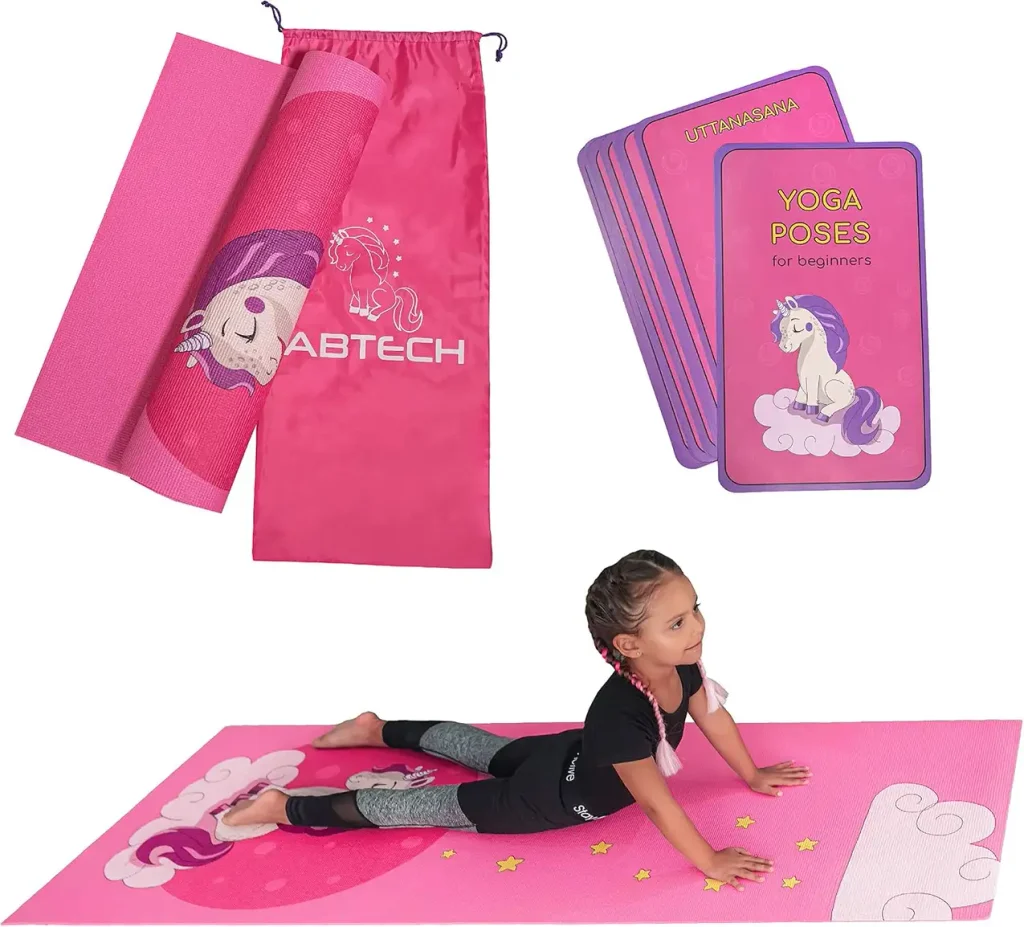
Best for: The learn-through-play kit, a mat plus illustrated pose cards plus carry bag in one gamified box.
- 12 Illustrated Pose Cards: The practice becomes a game kids deal themselves.
- Mat, Cards, and Bag Together: One purchase that outfits the whole ritual.
- Unicorn Colorway: The pink set with a matching illustrated deck.
- Play-Mat Padding: Comfort tuned for floor games and story poses.
- Mindfulness-Format Pedigree: The kit style learning-focused reviewers single out.
Pros:
- The complete out-of-the-box kids’ yoga kit
- Cards that extend practice beyond the mat
- Gift-ready packaging that needs no wrapping
Cons:
- Set tag above every single-mat pick here
- Deck that can wander off piece by piece
- Mat gauge lighter than the cushion-focused builds
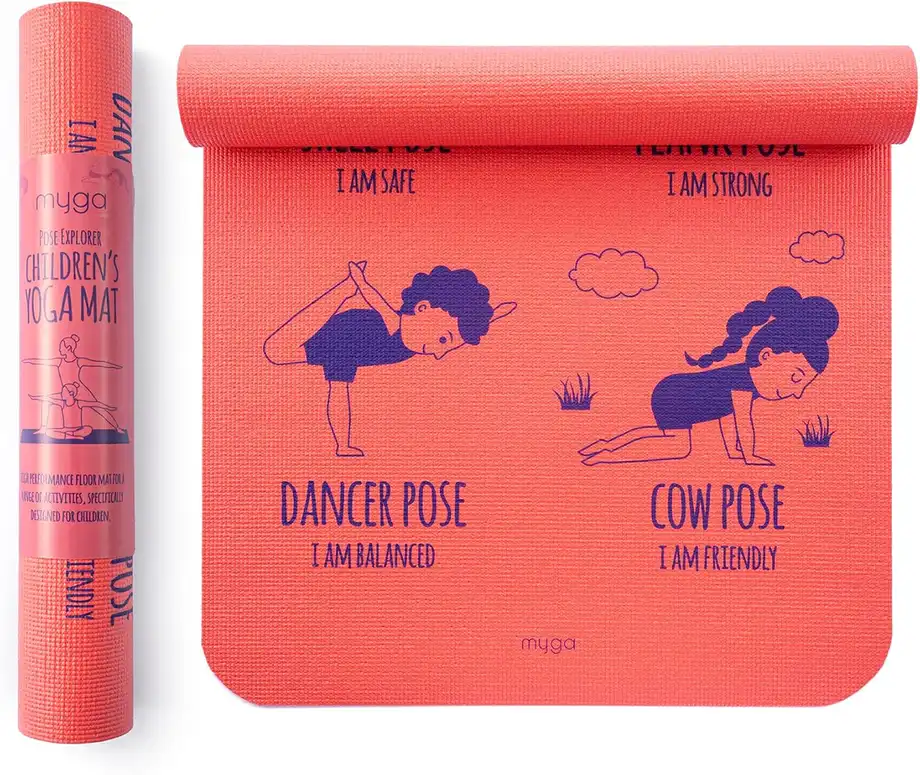
4. Myga Childrens Yoga Mat — 8 Poses Printed on the Reverse
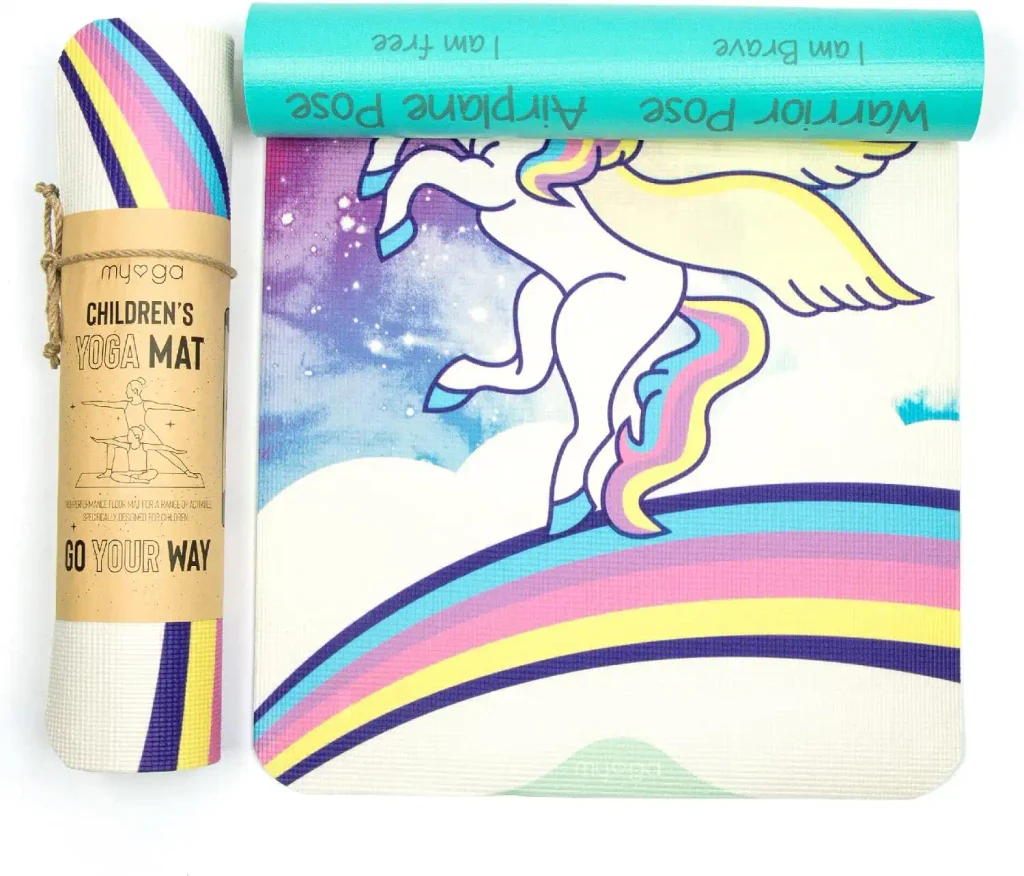
Best for: The self-guided surface, eight illustrated poses on the reverse so kids run their own class.
- 8-Pose Instructional Reverse: Numbered illustrations that turn the mat into a teacher.
- Eco-Friendly Printed PVC: A greener build beneath the guidance.
- Wipe-Clean Surface: Juice-day proof by design.
- Brand-Direct Storefront: The maker’s own listing behind every mat.
- Self-Guided Learning: Practice that continues when the adult leaves the room.
Pros:
- The genuine learn-the-poses mat in the guide
- Instruction that scales from tots to tweens
- Brand-direct accountability on a focused design
Cons:
- Instruction lives on the reverse, hidden mid-flow
- Coral palette that limits color choice
- Smaller owner pool than the benchmark prints
Teach With the Myga Poses Mat on Amazon
5. Bean Products Kids Non-Slip Yoga Mat, 60″ x 24″ (Blue Panda)
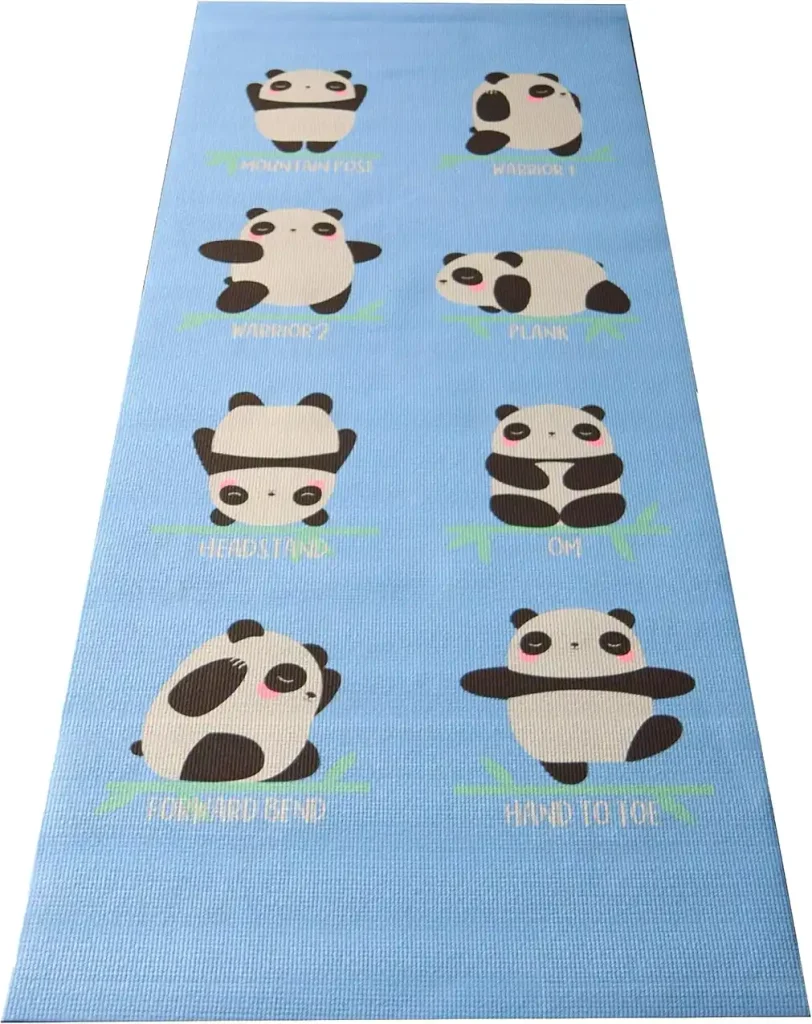
Best for: The grippy eco build, a panda-printed mat with the non-slip crown and easy-clean PVC.
- Non-Slip Crown Standing: The grip-focused pick among kids’ mats in expert testing.
- Blue Panda Print: Cartoon pandas mid-pose across a bright blue field.
- Eco PVC, Easy-Clean: A surface that forgives the messiest session.
- True Kids 60×24 Size: The dedicated children’s build, not an adult cut-down.
- Rolls Up Light: Storage that respects small arms.
Pros:
- The guide’s surest grip under playful chaos
- Distinctive panda art kids adopt as theirs
- Family brand with decades of mat experience
Cons:
- Merchant-fulfilled shipping that runs slower than Prime lanes
- Low stock on the blue panda colorway
- Return shipping may come out of the buyer’s pocket
Grip On With the Bean Panda on Amazon
6. Hello Fit Bulk Kids Yoga Mats, 10-Pack, 60″ x 24″, 4mm (Assorted)
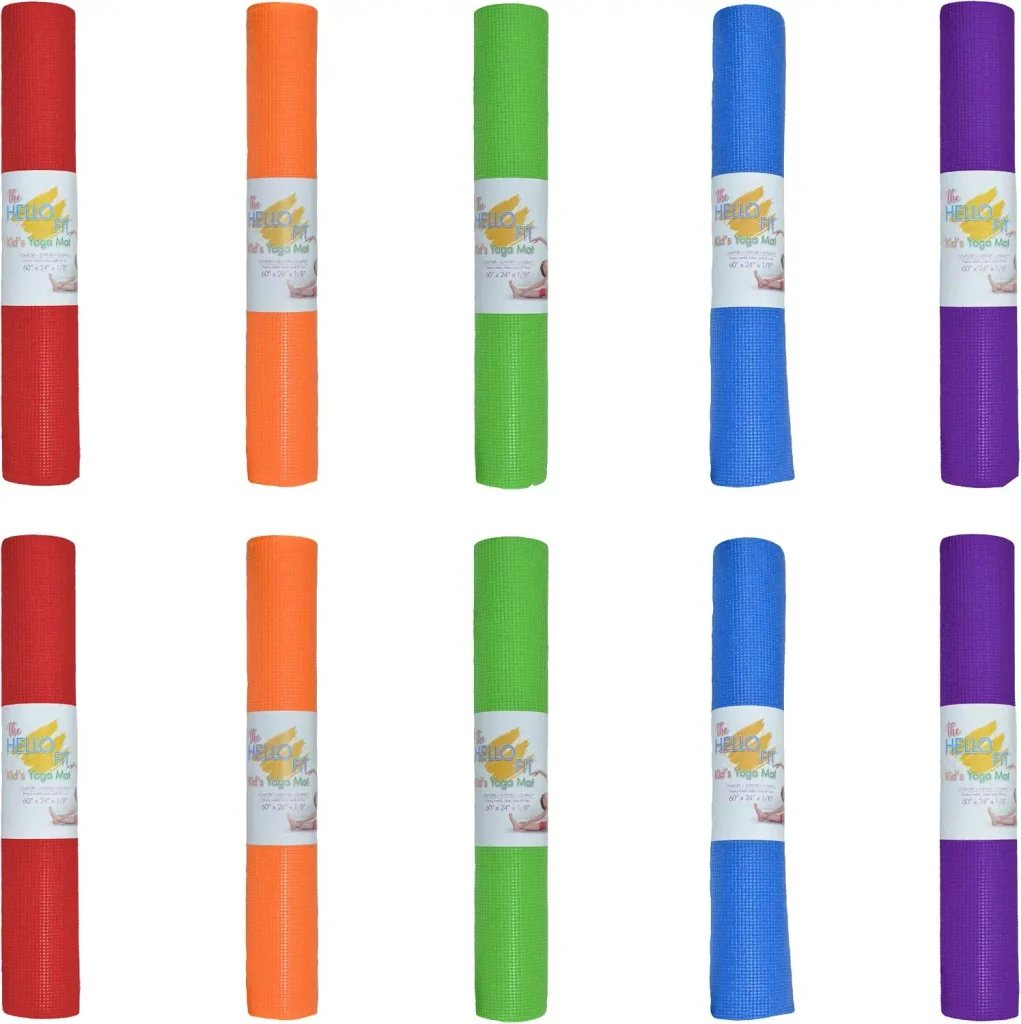
Best for: The classroom pack, ten four-millimeter mats in five colors for playgroups and kids’ studios.
- Ten Mats, Five Colors: A full class rolling in rainbow order.
- 4mm Shared Gauge: A cushion step above the single-mat standard.
- Non-Toxic, Easy-Clean Build: Classroom-grade surfaces that wipe between sessions.
- Per-Mat Value: The deepest coverage per dollar in the guide.
- Institutional Format: Built for studios, schools, and shared spaces.
Pros:
- The only sensible buy for group settings
- Per-mat cost that undercuts every single pick
- Color spread that ends the whose-is-whose debate
Cons:
- Household overkill for a single child
- Thin owner record for an institutional format
- Stack storage that claims real closet width
Equip the Class With the Hello Fit on Amazon
7. Myga Silk Print Kids Yoga Mat (Pose-Design Play Mat)
Best for: The lightweight play mat, a numbered pose print on the lightest wipe-clean build in the guide.
- Numbered Pose-Design Print: Ten illustrated poses turn floor time into follow-along time.
- Silk-Print Surface: Smooth, lightweight face tuned for play over athletics.
- Featherweight Roll: The easiest mat in the guide for a preschooler to carry.
- Brand-Direct Storefront: The same maker as the guide’s instructional mat.
- Second Myga Design: A play-first sibling to the reverse-print build.
Pros:
- The lightest, most toddler-friendly mat here
- Pose art that works for follow-the-leader games
- Wipe-clean practicality at the guide’s mid value tier
Cons:
- Thinner owner pool than any pick above it
- Low stock flag on the pose colorway
- Play-weight padding that hard floors will broadcast
Play Through the Myga Silk Mat on Amazon
8. Plyopic Kids Yoga Mat — TPE 6mm, PVC-Free, Carry Strap (Flamingo Pink)
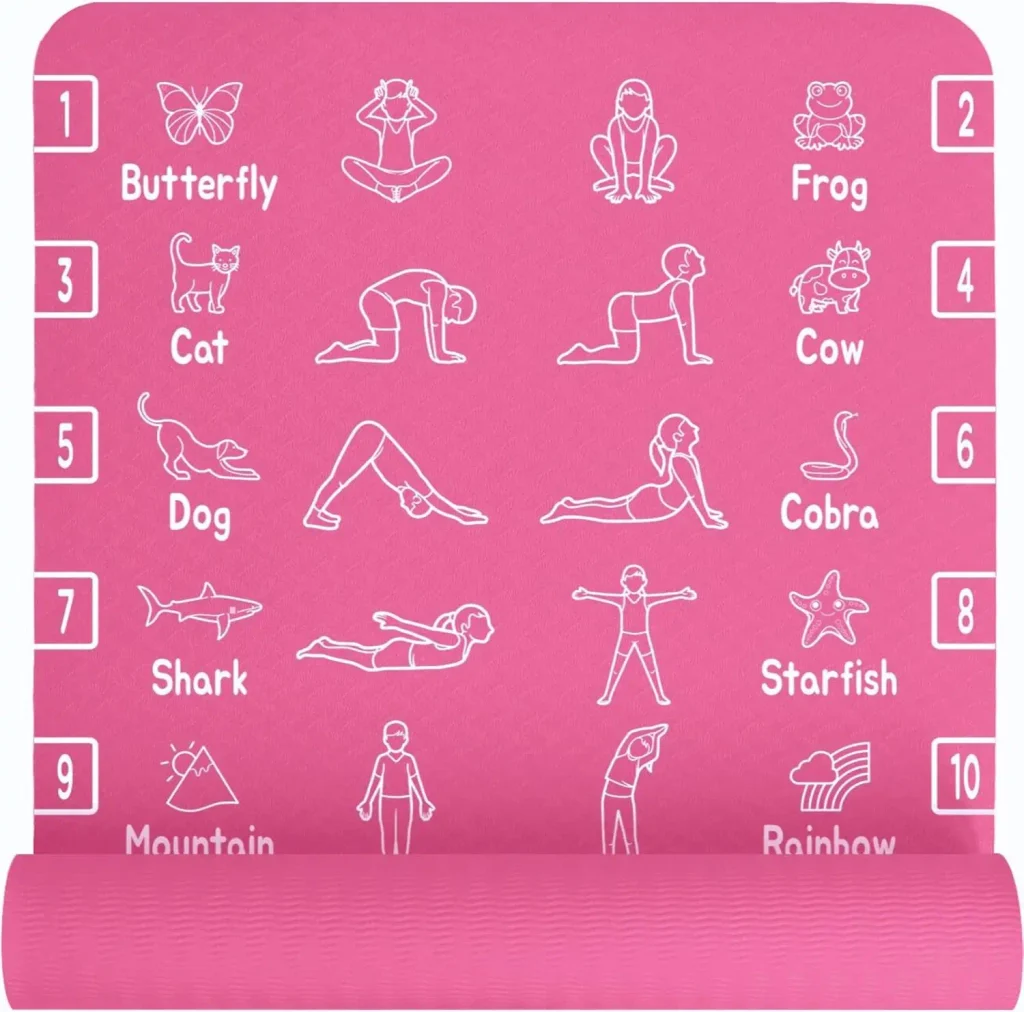
Best for: The maximum-cushion build, six millimeters of PVC-free TPE under a pose-guide print with a carry strap.
- 6mm Dual-Texture TPE: The deepest cushion in the guide, no PVC content.
- Pose-Guide Print: Animal-pose illustrations that coach from the surface.
- Carry Strap Included: Small shoulders get a proper handle.
- Ages 3-12 Span: A build that grows across the whole kids’ range.
- Expert-Crowned Design: The page-two overall pick from kids-yoga testing.
Pros:
- The kindst ride for knees and hard floors
- PVC-free material story for strict households
- Strap-and-roll system kids can own end to end
Cons:
- The steepest single-mat tag in the guide
- Young listing still writing its record
- Thicker roll that bulkier to store than 3mm builds
Strap Up the Plyopic Six on Amazon
Frequently Asked Questions
Q1: What size yoga mat fits a child?
A: The sixty-by-twenty-four-inch kids’ standard covers most school-age children comfortably, giving real practice room without the wandering space of an adult mat, and it matches the size every pick in this guide uses. Thickness matters alongside length, three millimeters suits five-to-eight-year-olds on carpet or for lighter practice, while six millimeters earns its keep for toddlers, hard floors, and knee-heavy play. The working test is ownership, a child should be able to roll the mat and carry it themselves, because gear that requires an adult’s help becomes an adult’s chore, and the habit-forming magic of kids’ yoga lives in the rituals a child can own end to end.
Q2: What do the safety labels on kids’ mats actually mean?
A: Three labels carry the conversation. 6P-free on a PVC mat means the six phthalate plasticizers regulators worry about have been engineered out of the material, and phthalate-free states the same intent more broadly. PVC-free, usually paired with TPE construction, removes polyvinyl chloride from the equation entirely, which is the stricter standard many households prefer for gear that sees faces and hands daily. Beyond the label, print quality matters, established brands state their surface safety openly, and a mat that documents its materials is generally one that tested them. Whatever tier a family chooses, the label reading takes one minute and settles the question for years.
Q3: How thick should a kids’ yoga mat be?
A: Match the gauge to the floor and the age. Three millimeters, the classic kids’ standard, keeps the mat light enough for small hands to roll and suits children whose practice stays low and playful, especially over carpet. Six millimeters is the comfort tier for hard floors, toddlers, and any session heavy on knees and seats, trading lightness for cushion in exactly the way adult mats do. The one wrong answer is buying thick for thickness’s sake, because an over-padded mat gets heavy, stores bulky, and usually ends up under a bed instead of under a child. Choose by floor first, age second, and the child’s carrying enthusiasm third.
Q4: How do you clean a kids’ yoga mat?
A: A damp cloth with mild soap handles the weekly wipe, and spot-cleaning after juice incidents should not wait for the schedule. PVC mats tolerate the damp-cloth routine generously, TPE prefers gentler soap and less soaking, and every mat air-dries rolled-out for a few minutes before storage, since trapped moisture is what turns a clean mat musty. Machine washing and bathtubs are overkill that can stress prints and seams, and commercial sprays are unnecessary for a surface mild soap already handles. The habit worth building is ownership, wiping the mat becomes part of rolling it up, and a five-year-old with a spray bottle and a cloth will defend that ritual fiercely.
Q5: How do printed pose guides help children practice?
A: They convert instruction into play, which is the only teaching method young children trust. A mat with numbered pose illustrations lets a child run their own session, following pictures instead of waiting for direction, and the autonomy is precisely what makes the practice stick, the same reason card-based kits work, they turn poses into a game children deal and shuffle themselves. Pose prints also quietly standardize form, the picture sets the target and children self-correct against it, which spares the adult in the room a running commentary. For households where a parent does not practice themselves, a self-guided surface is often the difference between yoga happening and yoga being scheduled.
Final Verdict
A kids’ mat earns its place on the playroom floor the same way any family gear does, by matching the child who will use it and the mess that will find it, and the checklist is short, honest materials under small hands, cushion that suits the floor, and a surface that makes practice feel like play. Every mat in this guide carries that logic in a different direction, benchmark prints and cushioned TPE, pose-guide surfaces and full-classroom packs. If you want the best kids yoga mats, don’t overthink it—these are already:
✔ Kid-Safe Materials
✔ Play-First Designs
✔ Small-Yogi Sizing
Best Overall Pick – Gaiam Kids Twinkle Toes (The Category Benchmark)
Best Learning Kit – Abtech Pose-Card Set (The Game-Ready Box)
Best Cushion Build – Plyopic TPE 6mm (The Knee-Saver)
Best Classroom Pack – Hello Fit 10-Pack (The Studio Stack)